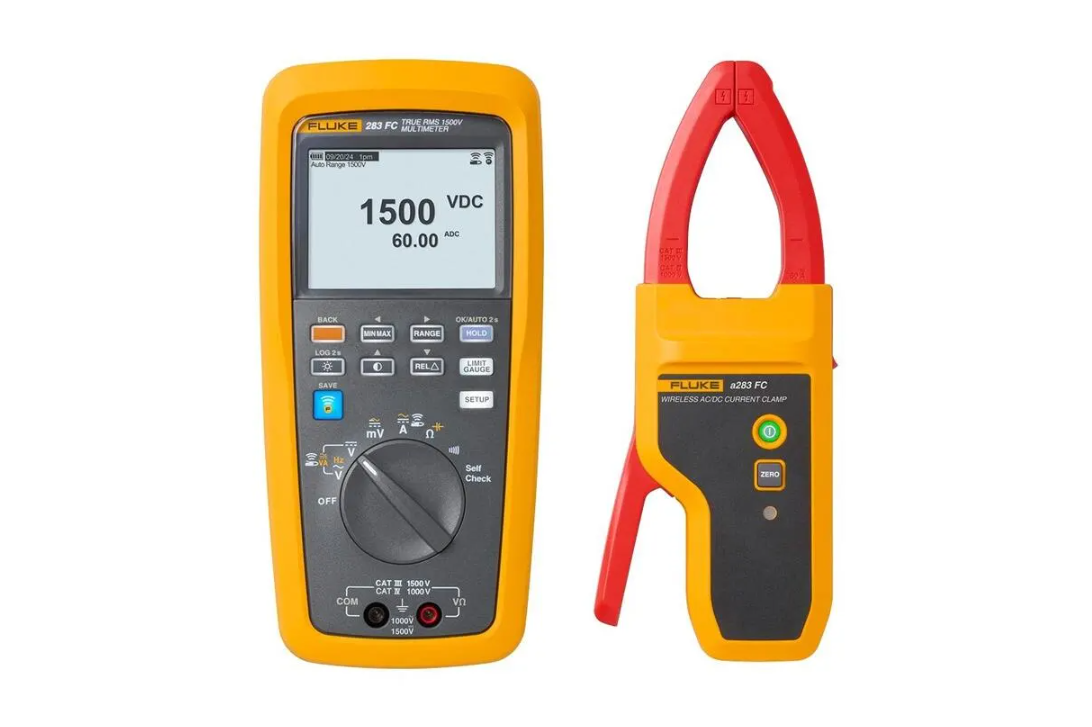
From basic field diagnostics to advanced industrial troubleshooting, digital multimeters are the foundational instrument for any electrical professional. Accurate, durable, and safety-rated for demanding environments.
A digital multimeter (DMM) is an instrument that combines the capabilities of a voltmeter, ammeter, and ohmmeter in a single handheld device. Professional-grade multimeters go well beyond these basics, offering capacitance measurement, frequency testing, diode checks, temperature probing, and in many cases, wireless data logging.
When selecting a multimeter for field or industrial use, the single most important consideration is the instrument's safety rating. The IEC 61010-1 standard defines Overvoltage Installation Categories — CAT I through CAT IV — based on the magnitude and transient energy of electrical environments. Choosing a meter with an adequate CAT rating is not optional in professional settings; it is a fundamental safety requirement.
Beyond safety, accuracy specifications determine how reliably the meter's readings reflect true electrical conditions. Accuracy is typically expressed as a percentage of reading plus a number of digits (e.g., ±0.09% + 2 digits for DC voltage). True RMS (Root Mean Square) capability is essential when working with non-sinusoidal waveforms, motor drives, or any circuit containing switching components. A meter without True RMS will produce incorrect readings in these conditions.
Measure supply voltages, signal levels, and potential differences across components with high resolution and accuracy.
Measure current through circuits using test leads or clamp accessories. Critical for load analysis and motor diagnostics.
Check circuit integrity, identify open connections, verify bonding, and measure component resistance values.
Test capacitors in power supply circuits, motor start capacitors, and filtering components for correct values.
Analyze pulse width modulation, verify supply frequency, and troubleshoot timing circuits in control systems.
With K-type thermocouple adapter, measure surface and air temperatures during electrical load testing or motor audits.
The following specification ranges represent the professional-grade digital multimeters available through Fluke Promotions. Specific values vary by model; contact us for detailed datasheets on any particular configuration.
| Parameter | Entry Level | Professional | Advanced |
|---|---|---|---|
| DC Voltage Accuracy | ±0.5% + 3 | ±0.09% + 2 | ±0.025% + 2 |
| AC Voltage (True RMS) | ±1.5% + 5 | ±0.7% + 3 | ±0.2% + 3 |
| DC Current Accuracy | ±1.5% + 5 | ±0.5% + 3 | ±0.2% + 2 |
| Resistance | ±1.0% + 3 | ±0.4% + 1 | ±0.2% + 2 |
| Max Voltage Input | 600V | 1000V | 1000V |
| Max Current Input | 10A | 10A | 20A |
| Frequency Range | 45–500 Hz | 5 Hz–50 kHz | 0.5 Hz–200 kHz |
| Capacitance Range | 1 nF – 1 mF | 0.01 nF – 9.999 mF | 0.01 nF – 9.999 mF |
| Safety Rating | CAT III 600V | CAT III 1000V / CAT IV 600V | CAT IV 1000V |
| Display | 4000 count | 6000 count | 50000 count |
| Connectivity | None | Bluetooth LE | Bluetooth + USB |
| Data Logging | — | Up to 10,000 readings | Up to 100,000 readings |
| IP Rating | IP40 | IP54 | IP67 |
| Operating Temp | 0°C to +50°C | –10°C to +55°C | –20°C to +55°C |
| Battery Life | ~200 hours | ~400 hours | ~300 hours (with backlight) |
Accuracy is expressed as ± [% of reading] + [number of least significant digits]. Both error components must be considered when evaluating measurement uncertainty in critical applications.
Maintenance technicians rely on multimeters for motor circuit analysis, drive output verification, sensor signal checking, and PLC input/output diagnostics. High-accuracy AC/DC measurements and True RMS capability are essential in environments with variable frequency drives and switching power supplies.
Electrical contractors working on commercial installations use multimeters throughout their daily workflow — from verifying supply voltages before work begins to final circuit testing after installation. The ability to log readings and transfer data to reporting software reduces documentation time significantly.
Solar PV installers and wind turbine technicians require multimeters capable of measuring high DC voltages safely and accurately. String voltage and current measurements during commissioning, open-circuit voltage checks, and inverter output verification are common tasks in this field.
Engineers in research and development environments need benchtop or high-count portable meters with superior resolution. Component characterization, prototype circuit debugging, and calibration verification require instruments with tighter accuracy specifications than typical field meters.
Understanding IEC 61010-1 Overvoltage Installation Categories is essential before selecting a multimeter. The CAT rating system describes the transient overvoltage conditions a meter is designed to withstand safely.
Always select a meter rated for the CAT level of the circuit you are working on, or higher. Using a meter with an insufficient CAT rating in high-energy environments can result in arc flash, instrument failure, and serious injury. Consult IEC 61010-1 and local electrical safety regulations for specific requirements in your region.
True RMS (Root Mean Square) is a measurement method that accurately calculates the effective heating value of any AC waveform, regardless of its shape. Average-responding meters are calibrated assuming a pure sine wave; they give correct readings only on clean sinusoidal signals. In circuits with variable frequency drives, switching power supplies, dimmer controls, or non-linear loads, the waveform is distorted, and average-responding meters can produce errors of 40% or more. True RMS meters measure the actual waveform and compute the correct result regardless of distortion, making them essential for modern industrial environments.
Calibration intervals depend on usage intensity, environmental conditions, and the accuracy requirements of the application. Most manufacturers recommend annual calibration under normal conditions. For instruments used in safety-critical measurements, quality-certified environments, or under harsh conditions (high temperatures, vibration, frequent drops), more frequent calibration may be warranted. Always check that calibration records are current before using any meter for compliance testing or work that will be referenced in official documentation.
Both ratings describe specific safety performance, but they address different parameters. The CAT level indicates the transient energy the meter can safely withstand — CAT IV represents higher-energy environments closer to the utility supply. The voltage figure indicates the maximum working voltage. A CAT IV 600V meter is designed for higher-transient environments at up to 600V working voltage, while a CAT III 1000V meter is rated for 1000V working voltage in a lower-transient category. For most distribution panels and industrial switchgear, CAT III 1000V is appropriate. Utility service entry and equipment connected directly to overhead lines requires CAT IV.
Standard digital multimeters are not suitable for insulation resistance testing. Insulation testing requires a dedicated insulation resistance tester (megohmmeter) that applies a known high DC voltage — typically 500V, 1000V, or 2500V — to stress the insulation and measure its resistance in the megaohm or gigaohm range. Standard multimeters measure in ohms using a low test voltage (typically 0.5V–2V), which is entirely insufficient to detect compromised insulation that appears intact at low voltages but breaks down under operating conditions.
Professional multimeter configurations often include: clamp adapters for current measurement without circuit interruption; K-type thermocouple probes for temperature measurement; alligator clip leads for hands-free connection; backprobe pins for testing connector pins without back-probing damage; magnetic hangers for meter mounting during two-hand operation; and carrying cases for transport protection. Wireless connectivity models may work with companion software applications for data logging, trend graphing, and measurement reporting. Always verify that any accessory is rated for the same CAT level as the meter and the environment.
Our technical team can help you identify the appropriate instrument based on your specific application, environment, and accuracy requirements. Get in touch with your questions.