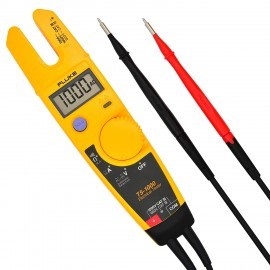
Purpose-built electrical test instruments designed for installation commissioning, periodic inspection, and everyday circuit verification. From simple socket testers to comprehensive multi-function installation testers, these tools support compliance with wiring regulations and safety standards.
While a digital multimeter handles general-purpose measurement, certain electrical testing tasks require dedicated instruments engineered specifically for the job. Insulation resistance testing, earth loop impedance measurement, RCD performance testing, and prospective fault current calculation each involve test methodologies, voltages, and current levels that require purpose-built hardware designed to IEC 61557 and related standards.
Multi-function installation testers combine most of these capabilities into a single instrument — allowing electricians and inspection contractors to carry one device rather than several. This consolidation reduces setup time, simplifies calibration management, and makes the workflow more systematic.
Simpler dedicated testers — socket testers, RCD testers, continuity testers, and voltage indicators — remain valuable tools for quick checks and for situations where a full installation test is not required. Their straightforward operation makes them suitable for non-specialist staff performing routine verification tasks.
Measure earth fault loop impedance to verify that protective devices will operate within required disconnection times under fault conditions.
Apply controlled test voltages to verify the integrity of insulation in cables, windings, and switchgear before energisation or during periodic inspection.
Verify that residual current devices trip at the correct current and within the time limits specified by the applicable wiring standard.
Plug-in devices that quickly verify the correct wiring of mains socket outlets. They indicate the presence of live, neutral, and earth conductors, and identify common wiring faults such as reversed polarity, missing earth, and swapped neutral-earth connections using LED indicators or a display.
Models with built-in RCD test capability can initiate and verify the RCD protection on the circuit without additional test equipment.
Non-contact and contact voltage indicators confirm whether conductors or equipment are live before work begins. They are essential safety tools used to verify that circuits have been de-energised correctly as part of isolation procedures.
Two-pole voltage testers provide a more precise indication with rated voltage display, satisfying the requirements of standards that specify a specific type of voltage verification before beginning work on isolated equipment.
Megermeters apply a controlled DC test voltage (typically 250V, 500V, 1000V, or 2500V) and measure the resistance of insulation between conductors and between conductors and earth. They are used to verify cable insulation before initial energisation, after repairs, and during periodic electrical inspections.
The test results indicate insulation condition on a scale from acceptable through warning to reject, and trending of results over time can indicate gradual deterioration before failure occurs.
Comprehensive instruments combining loop impedance, insulation resistance, continuity, RCD testing, prospective fault current measurement, voltage and frequency measurement, and often power quality analysis in a single unit. Required for full electrical installation verification to IEC 60364 or BS 7671 (UK).
Advanced models include memory storage for hundreds of test results, direct transfer to PC reporting software, and step-by-step test sequencing that guides the operator through the required tests in the correct order.
| Parameter | Basic | Professional |
|---|---|---|
| Test Voltages | 500V, 1000V | 250V, 500V, 1000V, 2500V |
| Resistance Range | 0.1 MΩ – 20 GΩ | 0.1 MΩ – 200 GΩ |
| Accuracy | ±5% | ±3% |
| PI / DAR Testing | — | Yes |
| CAT Rating | CAT III 300V | CAT IV 600V |
| Memory | — | Up to 500 results |
| Test Function | Specification |
|---|---|
| Loop Impedance Range | 0.01 Ω – 999 Ω |
| Loop Impedance Accuracy | ±2% + 3 digits |
| Prospective Fault Current | Calculated from loop impedance result |
| RCD Trip Time Range | 0 – 999 ms |
| RCD Test Currents | ½ × I△n, 1 × I△n, 2 × I△n, 5 × I△n |
| Continuity Resistance | 0.01 Ω – 999 kΩ |
| Continuity Test Current | ≥200 mA (reversible) |
| Insulation Test Voltages | 250 / 500 / 1000V DC |
| Voltage Measurement | 0 – 550V AC/DC |
| Memory Capacity | Up to 2000 test results |
| Standard Compliance | IEC 61557, EN 61010-1 |
| Communication | Bluetooth, USB, infrared |
Electrical installation testing in Europe is governed by a combination of international IEC standards and national implementation standards. The following documents are most relevant to the test instruments and procedures used in professional electrical inspection work.
Defines performance requirements for instruments used to test electrical safety in low-voltage distribution systems. Covers insulation resistance, earth impedance, earth resistance, continuity, residual current, and other measurements. Instruments should comply with the relevant parts of this standard for the tests they perform.
The international standard series for the design, installation, and testing of low-voltage electrical installations. Part 6 covers verification (initial inspection and testing). Defines the tests that must be performed to verify compliance of a new or modified installation before it is put into service.
Describes methods for measuring touch current and protective conductor current in electrical equipment. Referenced by equipment safety standards for the measurement of leakage current that could create a risk to persons in contact with electrical equipment.
Specifies general safety requirements for electrical test and measurement equipment, including the CAT rating system for overvoltage protection. All professional electrical test instruments should be assessed against this standard and carry appropriate CAT markings.
Electrical installation testing requirements vary by country and may be subject to local wiring regulations, national annexes to IEC standards, and regulatory authority requirements. Always consult the applicable national standard and local electrical safety regulations for the jurisdiction in which you are working. This content is for informational purposes and does not constitute regulatory advice.
A multimeter measures resistance using a low test voltage — typically 0.5V to 2V. This is entirely insufficient to stress insulation that may be compromised at operating voltage. An insulation resistance tester (megohmmeter) applies a controlled high DC voltage — 250V, 500V, 1000V, or 2500V depending on the application — and measures the resulting resistance in megaohms or gigaohms. This reveals insulation degradation that only becomes apparent when the insulation is subjected to voltage levels representative of operating conditions. The two instruments are not interchangeable for this purpose.
The Polarisation Index is a ratio test that compares the insulation resistance measured at 10 minutes to the reading at 1 minute of continuous test voltage application. Clean, dry insulation shows a rising resistance over time as charge accumulates, giving a PI value above 2.0. Contaminated or moisture-affected insulation stabilises more quickly, giving a lower PI value. IEEE 43 defines PI assessment criteria for rotating machine windings: a PI below 1.0 is generally considered a reject condition, while values above 2.0 indicate healthy insulation. The PI test provides more information than a single-time reading alone.
RCD (Residual Current Device) testing involves applying a test current equal to the rated trip current (I△n) and measuring the time taken for the device to operate. IEC 60364-6 and most national installation standards require that a standard RCD operating at I△n trips within 300 ms, and at 5 × I△n within 40 ms for 30 mA devices. Testing should also be performed at ½ × I△n to verify the device does not nuisance-trip at currents below its threshold. RCD testers apply these test currents through the phase terminal of the protected circuit while monitoring trip time with a millisecond-resolution timer. The test is also available on most multi-function installation testers.
Earth fault loop impedance (Ze or Zs) determines how much fault current will flow if a live conductor contacts an earthed metalwork. The fault current must be high enough to operate the overcurrent protective device — fuse or circuit breaker — within the disconnection time required by the installation standard (e.g., 0.4 seconds or 5 seconds depending on circuit type and voltage). If the loop impedance is too high, the fault current will be insufficient to operate the protection quickly enough, leaving dangerous touch voltages present for longer than permitted. Loop impedance testing verifies that the protective system will function correctly by measuring the complete fault current path from source to the test point and back to the supply neutral.
Whether you need a simple socket tester or a comprehensive multi-function installation instrument, our team can discuss the requirements for your application and testing environment.