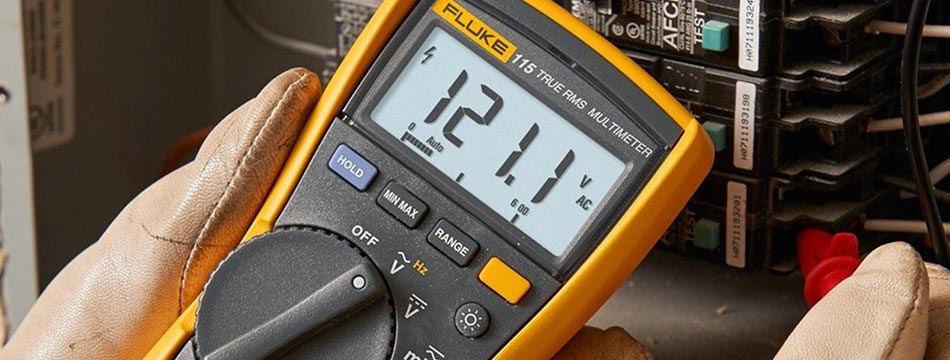
Walk into any electrical supply wholesaler and you will find digital multimeters at a wide range of price points, from inexpensive basic units to sophisticated instruments costing many times more. The challenge is not finding a multimeter — it is understanding which specifications actually matter for the work you need to do, and which can be treated as secondary considerations. This guide works through the key selection criteria in the order they should be evaluated.
Safety Ratings Come First
Before considering any performance specification, the safety rating of a multimeter determines whether it is appropriate to use on a given circuit at all. This is not a subject where preferences or budget trade-offs apply; using an inadequately rated instrument in a high-energy environment is a genuine safety hazard.
The relevant standard is IEC 61010-1, which defines Overvoltage Installation Categories — abbreviated as CAT ratings — for electrical measurement equipment. The CAT level reflects the maximum transient overvoltage an instrument is designed to withstand safely. Higher CAT numbers indicate higher-energy environments with more severe transient events.
CAT I — Protected signal circuits and electronics. CAT II — Single-phase loads from outlets. CAT III — Fixed three-phase installations, panels, distribution boards. CAT IV — Service entrance, utility connection, overhead lines.
For most commercial and industrial electrical work involving distribution panels, switchgear, and motor control equipment, CAT III 1000V is the appropriate minimum. Service entrance and utility-connected work requires CAT IV.
The voltage figure following the CAT designation (e.g., CAT III 600V or CAT III 1000V) indicates the maximum working voltage for that category. A CAT III 600V meter is not suitable for use on 690V three-phase systems, even though 600V sounds close. When in doubt, select a higher rating. The cost difference between a CAT III 600V and CAT III 1000V instrument is typically modest; the consequence of using an under-rated meter in a fault condition is not.
When reviewing CAT ratings, also check that the test leads supplied with the instrument carry the same rating. It is not uncommon for an entry-level package to include leads rated for a lower CAT level than the meter itself. In that situation, the overall system is limited by the rating of the leads, not the meter. Professional users should always verify lead ratings independently.
True RMS vs Average-Responding
The RMS (Root Mean Square) value of an AC voltage or current is the equivalent DC value that would produce the same heating effect in a resistive load. For a pure sine wave — the kind produced by a well-regulated utility supply — the relationship between RMS and average values is fixed and well-known. Average-responding meters exploit this relationship: they measure the average of the rectified waveform and multiply by a scaling factor (approximately 1.1107) to display the calculated RMS equivalent.
This approach works correctly only when the waveform is a pure, undistorted sine wave. In most modern industrial environments, it is not. Variable frequency drives, switched-mode power supplies, electronic lighting controls, UPS systems, and non-linear loads all distort the current waveform drawn from the supply. The result is a waveform with significant harmonic content — additional frequency components at multiples of the fundamental frequency — that makes the average-responding scaling factor incorrect.
The error introduced by average-responding measurement on distorted waveforms can be substantial. In circuits with switching components, the reading error on current measurement can reach 40% or more. For voltage measurement, the error is typically smaller but still meaningful for diagnostic work. In a practical example: if a true RMS current draw of 12 amps is displayed as 9 amps on an average-responding meter due to waveform distortion, any conclusions drawn from that reading about circuit loading will be incorrect.
In circuits with variable frequency drives and switching power supplies, average-responding meters can introduce measurement errors that significantly affect diagnostic conclusions.
True RMS meters compute the actual RMS value of the waveform mathematically, regardless of waveform shape. They give correct readings on distorted waveforms, pure sine waves, and any waveform within their stated crest factor and bandwidth specifications. For any professional working in modern commercial or industrial environments, True RMS is not an optional upgrade — it is a necessary capability.
Understanding Accuracy Specifications
Multimeter accuracy is expressed in a standardised format: ± [percentage of reading] + [number of digits]. For example, a DC voltage accuracy of ±0.5% + 3 means the total error is the sum of 0.5% of the displayed reading plus 3 counts on the least significant digit of the display. Both components contribute to the total uncertainty.
Consider a 10.00V measurement on a meter with ±0.5% + 3 accuracy and a 4000-count display reading in 0.01V increments. The percentage component is 10 × 0.005 = 0.05V. The digit component is 3 × 0.01V = 0.03V. Total accuracy is ±0.08V, meaning the true value could be anywhere from 9.92V to 10.08V. For most diagnostic work, this is perfectly adequate. For calibration verification or precision component testing, it may not be.
Accuracy specifications are typically stated at a reference temperature (usually 23°C ± 5°C) and change when the meter is operated in different temperature conditions. Most specifications include a temperature coefficient — an additional error per degree Celsius — that applies when operating outside the reference range. For field use in hot or cold environments, this additional uncertainty should be factored into any precision measurements.
Display Resolution: Counts and Digits
Resolution describes the smallest increment that can be displayed. It is expressed either as a count value (e.g., 4000 counts, 6000 counts, 50000 counts) or as a number of digits with a fraction (e.g., 3½ digits, 4½ digits). A 4000-count meter can display values from 0.000 to 3.999, with the leading digit being either 0 or a number up to 3. A 6000-count meter adds one increment of resolution.
Resolution and accuracy are related but distinct. A high-resolution display shows finer increments, but those increments are only meaningful if the meter's accuracy specification is consistent with the resolution being displayed. There is no benefit in a display that shows 0.001V resolution if the meter's accuracy at that range is ±0.5% — the last digit is noise, not information.
For most field diagnostic work, 4000 to 6000 counts is adequate. For laboratory or calibration work requiring greater precision, 50000-count benchtop instruments or high-end portable meters offer the resolution and accuracy to match.
Measurement Functions Beyond the Basics
All digital multimeters measure voltage, current, and resistance. The additional functions available on professional instruments extend their usefulness considerably.
Capacitance measurement is useful for testing motor run capacitors, power factor correction capacitors, and components in electronic circuits. Most professional meters offer capacitance measurement across a useful range, though measurement time can be several seconds on large capacitors.
Frequency measurement allows verification of supply frequency and analysis of signal frequencies. Duty cycle measurement — available on many meters — is essential for working with pulse-width modulated signals in motor control circuits and lighting dimmers.
Diode testing checks the forward voltage drop of diodes and LEDs, useful for semiconductor diagnostics. Continuity tone provides an audible indication of a low-resistance path, allowing hands-free operation when checking circuit continuity.
Temperature measurement via a K-type thermocouple accessory adds thermal diagnostic capability to the meter. This is particularly useful during load testing of electrical equipment where monitoring temperature trends provides early warning of thermal stress.
Data logging allows the meter to record readings at intervals for later analysis. This is valuable for long-term monitoring applications — for example, recording supply voltage variation over 24 hours to identify sag conditions during peak load periods.
Environmental and Physical Considerations
The operating environment has a significant influence on which features matter most. A technician doing bench repair work has different requirements from a field engineer working in an outdoor substation in winter.
Ingress protection (IP) ratings indicate resistance to dust and moisture. IP54 — protected against dust ingress and water spray from any direction — is a practical minimum for outdoor field work. IP67 (dustproof, withstands immersion to 1 metre for 30 minutes) provides greater protection for demanding environments.
Drop resistance matters in field settings. Many professional meters are designed to survive drops from heights of one metre or more without losing calibration. Some include rubber holsters that absorb impact energy and provide grip. For workshop bench use, this is a secondary consideration; for rooftop PV installation or crane maintenance, it becomes important.
Backlit displays are essential for working in confined spaces, inside cabinets, or in outdoor environments where glare can make a non-backlit display difficult to read. Auto-backlight that activates on button press and turns off after a set time balances visibility with battery conservation.
Battery life varies considerably between models and is influenced by backlight usage, Bluetooth transmission, and other active features. For extended field deployment or applications where battery changes are inconvenient, check the specified battery life under typical operating conditions.
Common Selection Mistakes
Prioritising price over safety rating. The most common and consequential mistake is selecting an inexpensive meter with an inadequate CAT rating for the intended application. Safety ratings are non-negotiable and should be the first selection criterion.
Ignoring True RMS in modern environments. Many technicians working with VFD-driven systems or switch-mode power supplies continue to use average-responding meters and accept the readings as accurate. In these environments, the readings may be systematically wrong in a way that leads to incorrect fault diagnosis.
Confusing resolution with accuracy. A 50000-count display does not by itself indicate high accuracy. Always evaluate the full accuracy specification — not just the display count — before drawing conclusions about measurement precision.
Overlooking test lead ratings. As noted earlier, the test leads are part of the safety system. Always verify that leads are rated to at least the same CAT level as the meter and the circuit being tested.
Selecting a basic meter for occasional precision work. If an application occasionally requires a higher level of accuracy than a general-purpose meter provides, it is worth considering whether a separate higher-accuracy instrument is warranted for those measurements, rather than accepting known uncertainty in the results.
Selection Summary
The practical multimeter selection process begins with the safety rating required for the highest-energy environment the meter will be used in. This sets the minimum acceptable CAT level and voltage rating, and defines a subset of instruments suitable for consideration.
Within that subset, True RMS capability should be standard for any professional working in commercial or industrial environments. The presence of non-linear loads in virtually all modern facilities makes average-responding measurement unreliable for all but the most basic circuit verification tasks.
Accuracy requirements depend on the application. For general electrical diagnostic work, standard professional-grade accuracy (typically ±0.5% DC, ±1.5% AC) is adequate. For calibration support, precision component testing, or reference measurements, tighter specifications are warranted.
Additional functions — temperature, capacitance, frequency, data logging — should be selected based on the specific tasks the instrument will need to perform. It is generally more cost-effective to select a well-specified general-purpose instrument than to purchase a basic meter and then find that additional test equipment is required for common tasks.
For a detailed look at specific measurement functions, safety standards, and available instrument ranges, see the Digital Multimeters product section and the article on Electrical Safety Testing Best Practices.