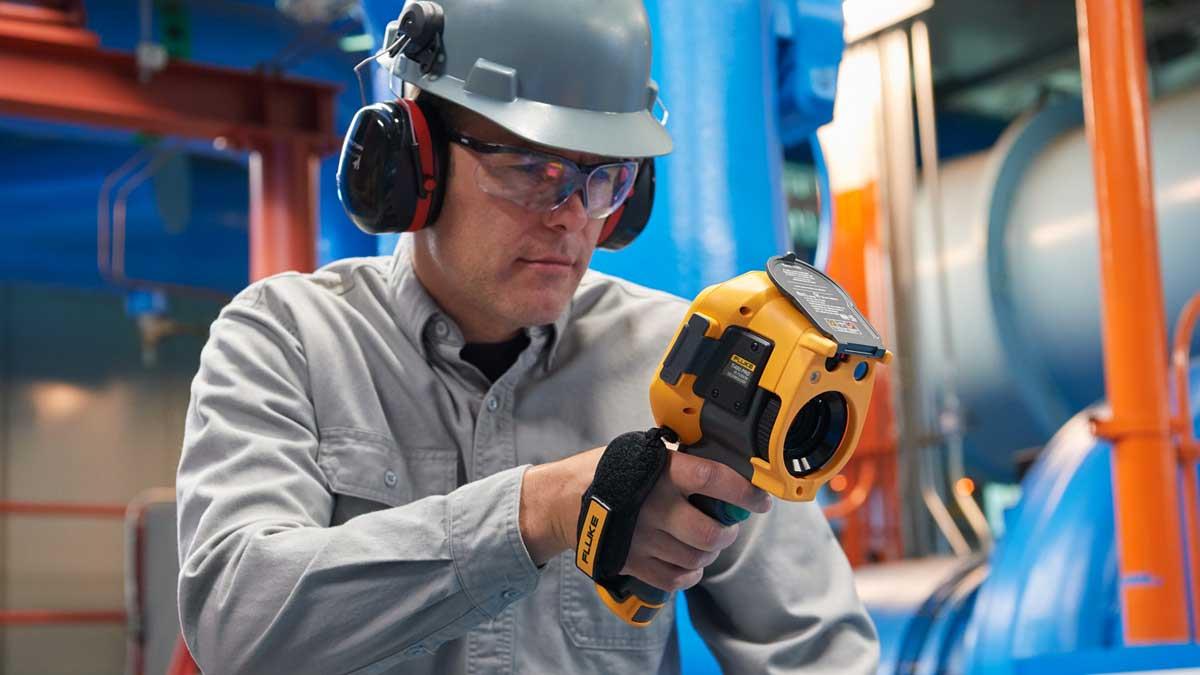
Infrared thermography has been used in industrial maintenance programmes for several decades. What has changed significantly in recent years is not the underlying physics — all warm objects emit infrared radiation — but the accessibility of the technology. Camera systems that once required specialist operators and significant capital investment are now available as practical tools for general maintenance teams, and the insight they provide into equipment condition continues to justify their place in a structured maintenance programme.
The Fundamentals of Infrared Detection
Every object with a temperature above absolute zero (-273.15°C) emits electromagnetic radiation. The wavelength at which this emission is strongest is inversely related to temperature — cooler objects emit predominantly in the far-infrared region (wavelengths of 8–14 micrometres), while hotter objects shift their peak emission towards shorter wavelengths. Thermal cameras used in industrial maintenance typically detect in this 8–14 micrometre range, which corresponds to the temperatures encountered in building and industrial applications.
The camera's microbolometer detector array converts the incoming infrared radiation into an electrical signal for each pixel, creating a temperature map of the scene. Professional radiometric cameras calibrate this map against known reference sources, assigning a temperature value to each pixel. This radiometric data — not just a visual image — is what allows the thermographer to make quantitative statements about temperatures and temperature differences rather than simply observing colour patterns.
Resolution matters significantly for industrial inspection. An 80×60 pixel detector provides very coarse imagery that makes precise temperature measurement on small targets unreliable. A 320×240 detector is adequate for most electrical panel surveys and general equipment surveys. A 640×480 detector provides the spatial resolution needed for detailed imaging of small components, surveying at greater distances, or producing images of sufficient quality for professional reporting.
Electrical System Inspections
The most widely applied use of thermal cameras in industrial maintenance is the inspection of electrical distribution systems under load. The principle is straightforward: wherever current flows through a resistance, heat is generated. In a healthy connection, the resistance is low and the heating is minimal. A loose, corroded, or degraded connection has elevated resistance, and the same current flow generates more heat — creating a thermal anomaly visible to the camera.
The value of this approach lies in its non-invasive nature and its ability to identify deteriorating conditions before failure. A termination screw that has worked slightly loose due to thermal cycling and vibration may not yet cause any operational issues — circuit current and voltage may be entirely normal — but its elevated temperature can be measured and documented months before it deteriorates to a point that causes a tripped breaker, damaged conductor insulation, or an arc fault event.
Thermographic surveys of electrical systems should be conducted with equipment under representative load — ideally above 40% of rated current — to ensure thermal anomalies produce sufficient temperature contrast for reliable detection.
Common targets for electrical thermography include: main incoming switchgear and busbars; sub-distribution boards and consumer units; motor control centres and starters; cable terminations in junction boxes; transformer connections and tap changers; and socket outlet circuits in commercial buildings. The scope of any survey should be defined in advance, and inspection access must be arranged so that the thermographer can image each target safely from an appropriate distance with the equipment covers open or windows provided.
Load conditions at the time of the survey must be documented. Thermal anomalies are proportional to the square of the current — at half the rated current, the heating from a defective connection is only a quarter of what it would be at full load. Low-load surveys may miss significant anomalies that would be clearly visible at higher loads. Where possible, surveys should be scheduled during periods of representative operational load, and load data should be recorded alongside the thermal images.
Mechanical Equipment Condition Monitoring
Rotating machinery generates heat through friction, and the distribution of that heat provides information about mechanical condition. Bearings running in good condition with adequate lubrication operate within a predictable temperature range relative to ambient. Bearings that are under-lubricated, overloaded, contaminated, or failing generate anomalous heat — often detectable by thermal camera well before any vibration signatures become pronounced or noise is audible.
For mechanical equipment monitoring, thermal cameras are most effective as part of a broader condition monitoring programme that includes vibration analysis and lubricant sampling. Thermal anomalies in bearings indicate that something is wrong, but may not definitively identify the cause. Correlated with vibration data, the picture becomes clearer and maintenance decisions are better informed.
Beyond bearings, thermal cameras are used to survey gearboxes (detecting oil starvation or internal wear), belt drives and couplings (detecting misalignment or tension problems), brake mechanisms (verifying uniform heat distribution after application), and pump casings (detecting internal recirculation due to cavitation or wear ring failure). Each of these applications requires the thermographer to understand what normal looks like for the specific equipment type, which argues for establishing thermal baselines during commissioning or after a recent overhaul.
Building Diagnostics
Building thermography is a distinct discipline from industrial electrical inspection, but the same cameras and many of the same principles apply. The goal in building diagnostics is typically to assess the thermal performance of the building envelope — identifying areas where insulation is missing, compressed, or bridged, and locating air infiltration pathways that contribute to energy loss and occupant discomfort.
Effective building thermography requires a temperature differential between inside and outside — typically at least 10°C, and preferably more — to make thermal anomalies visible. Surveys are most commonly conducted in winter, when heating creates a positive internal pressure and temperature differential that drives warm air and heat through envelope defects. The timing of the survey relative to solar radiation must also be managed; direct sunlight on a facade creates surface heating that can mask or mimic thermal anomalies for several hours after sunset.
Interior surveys from inside the building are used to identify cold spots, interstitial condensation risk areas, and missing insulation. Exterior surveys show the overall heat loss pattern of the facade and can identify areas of elevated heat loss from a broader perspective. Both perspectives provide useful information and are often used together on comprehensive building assessments.
Emissivity and Measurement Accuracy
Emissivity is the ratio of radiation emitted by a real surface to the radiation that would be emitted by a perfect blackbody at the same temperature. It ranges from 0 to 1. Most non-metallic materials have high emissivity (0.85–0.98) and behave approximately like blackbodies for practical thermographic purposes. Bare metals, particularly polished or clean metallic surfaces, have much lower emissivity — pure copper can be as low as 0.02–0.10 — and produce misleading temperature readings if the camera is set for high emissivity.
For electrical inspection work, cable insulation, painted enclosures, and phenolic terminal blocks all have high emissivity and require little correction. Bare copper busbars and aluminium conductors require either correct emissivity settings (using a reference table or measured value) or the application of high-emissivity tape to the measurement point. Many experienced thermographers carry a roll of high-emissivity tape specifically for use on metallic surfaces where accurate spot temperatures are needed.
In addition to emissivity, reflected apparent temperature — the temperature of infrared radiation being reflected by the target surface from its surroundings — must be corrected for accurate absolute temperature measurements. Professional cameras include settings for both emissivity and reflected temperature compensation.
Structuring the Inspection Workflow
Ad hoc thermographic inspection provides some value, but significantly less than a structured programme with consistent methodology. A well-designed inspection workflow includes pre-survey planning, systematic image capture, real-time anomaly assessment, and structured documentation.
Pre-survey planning identifies the equipment to be surveyed, the access requirements and permits needed, the load conditions required, and any specific safety considerations. For large facilities, a route plan that sequences the inspection logically reduces walking time and ensures complete coverage. Previous inspection records should be reviewed to identify known defects and track their progression.
During the survey, both thermal and visible-light images should be captured for every identified anomaly. The thermal image shows the temperature distribution; the visible image shows the physical context that identifies the component and its location in the installation. Without the visible image, a thermal hot spot can be difficult to locate during follow-up maintenance.
Environmental data — ambient temperature, humidity, and any significant changes in conditions during the survey — should be recorded. This data contextualises the temperature readings and allows meaningful comparison between surveys conducted under different conditions.
Reporting and Follow-Up
The value of a thermographic inspection is realised through the corrective actions it enables. A survey report should provide clear information about the location, nature, and assessed severity of each finding, along with a recommended action and priority classification. Without this structure, findings can be lost in general maintenance backlogs or deprioritised inappropriately.
Severity classification systems for electrical thermal anomalies typically categorise findings based on the temperature rise above reference — the temperature of similar components under the same load conditions. Minor temperature rises (3–10°C above reference) warrant monitoring and investigation. Significant rises (10–30°C) indicate a defect requiring planned correction. Severe anomalies (above 30°C) indicate an immediate or near-term risk and should be flagged for urgent attention.
Follow-up verification surveys after corrective maintenance confirm that repairs have been effective and that no new anomalies have been introduced. This closing of the inspection-maintenance loop is an essential part of a quality thermographic programme and provides documented evidence that identified hazards have been addressed.
Thermal cameras provide surface temperature data. For full diagnostic certainty, thermal findings are most useful when correlated with electrical measurements from a multimeter or installation tester, vibration analysis for mechanical equipment, and historical maintenance records. The thermal image identifies where to look more closely; the additional measurements explain what is happening.